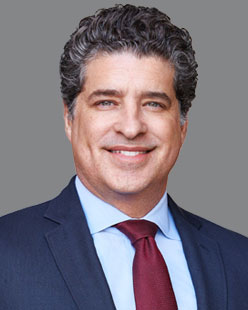
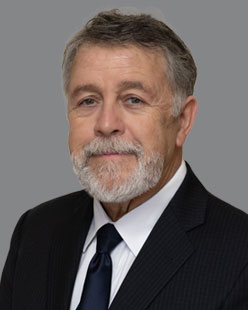
Eric Ivary, Esq.
Case Manager: Kathleen Emma
Tel: (415) 772-0900 Ext. 14
E-Mail
BACKGROUND
In 2001, after a 30-year career as a highly successful trial lawyer,
Eric Ivary, Esq. became a full-time mediator, arbitrator and referee. As
a member of ABOTA and the ATLA, he is frequently selected as a neutral
in situations where counsel values his ability to gain the trust of the
participants. He is also known for his ability to grasp complex subject
matter, particularly employment related disputes, and communicate the
issues effectively to counsel and their represented parties. This
ability to communicate intricate matters and gain the trust of the
participants makes him particularly well suited for the most challenging
cases.
LITIGATION EXPERIENCE
Founding Partner, Gwilliam, Ivary, Chiosso, Cavalli & Brewer
(1978-2000), Oakland, California.
• Worked principally as a trial lawyer, trying medical malpractice and
employment as well as insurance bad faith.
• Also tried or handled virtually all other types of personal injury and
product liability cases, including aviation accident
cases.
• Served as the firm’s Vice President and Managing Partner.
ALTERNATIVE DISPUTE RESOLUTION (ADR) EXPERIENCE
• Has mediated over 100 cases involving:
o Employment (wrongful termination, retaliation, age & gender
discrimination)
o Personal Injury
o Medical/Hospital Malpractice
o Public Entity Liability
o Civil Rights
o Police/Fire Misconduct
o Insurance (coverage denials, failure to defend, bad faith)
• Mediator and Arbitrator for contractual arbitrations, including the
Kaiser System and Uninsured Motorist proceedings.
• Appointed to the American Arbitration Association Panel of
Arbitrators.
• Judge Pro Tem for the Superior Courts for three Bay Area Counties
since 1989.
• Mediator for the United States District Court ADR Program in the
fields of Employment, Federal civil rights, Medical
Malpractice, ERISA, ADA and Jones Act as well as Federal Tort claims.
• Panelist for all the Alameda County Settlement Programs (since 1985).
• Panelist for the Contra Costa County Courts programs (since 1991).
• Panelist for San Mateo County Courts MAP Program (since 2008).
• Panelist for Santa Clara County Court
EDUCATION
• B.A., Saint Mary’s College of California, 1968
• J.D., University of Santa Clara, 1971
• Admitted to State and Federal Courts, 1972
• Continuing Education requirements met in all fields, including
Advanced Mediation Training for both Sate and Federal
courts
MEDIATION TRAINING
• Initial training through San Mateo, Contra Costa and Alameda County
court sponsored ADR Programs (MAP, EASE,
SMART and TOT programs)
• 40 Hour Intensive Mediation Training course taught by Nancy Yeend
(2001)
• 20 Hour US District Court training program
• Multiple CLE programs on a variety of topics, as well as regular
updates on specific mediation issues on interest (including
confidentiality, changes in the law, etc.)
PAST & PRESENT PROFESSIONAL ASSOCIATIONS
• Mediation Society
• Northern California Mediation Association
• American Board of Trial Advocates, inducted 1989
• American Inns of Court, Wiley Manuel Chapter, Senior Mentor, 1999-2000
• Association of Trial Lawyers of America, (Advocate, National College
of Advocacy)
• Alameda-Contra Costa Trial Lawyer’s Association
o Board of Governors, 1975-1990
o Editor of The Verdict, 1986
o President, 1990
• Alameda County Lawyer’s Club
AWARDS & HONORS
• Lawyer of the Year, Alameda County Lawyer’s Club, 1995.
• Selected as Evaluator by the CEB Trial Advocacy Program.
• State Bar Commendation for Outstanding Contributions to Pro Bono and
Voluntary Legal Services.
PUBLICATIONS
• Winning at Arbitration (book chapter) Bancroft Whitney (1992)
• Electronic Fetal Monitoring
• Medical Malpractice Jury Instructions
• Punitive Damages in Employment Cases
• Invited Panelist and Speaker to Employer Groups and Panelist for
Employment Law Seminars.
MEDIATION APPROACH
The best description of my approach to mediation is “facilitative”. But
experience has taught me to do what works and not get too caught up in
theory or the academic side of mediation. My goal is to get the case in
a position where the parties can see a clear path to settlement.
My approach varies because no two cases are alike. For example, an
employment case can be very sensitive to the parties involved as can a
police misconduct case or a medical malpractice case. Probably the best
way to describe my approach to mediation is that I do everything in my
power to be sure that the parties are dealing with their REAL case, not
the one they wish they had. This often involves asking both sides a lot
of questions, sometimes uncomfortable ones. (The tough questions are
asked in separate sessions).
When parties request I will become very active in their negotiations.
For a full explanation of my mediation style and philosophy, please
download an article I wrote for the SFTLA magazine. It can be found at
the ADR website (www.adrservices.org). Although originally written as a
practical guide for the plaintiff’s bar, it also tells the defense how I
approach mediation. My mediation style is also described in an article
published in The Recorder in 2005 entitled, “Love Thy Enemy”. This
article can also be downloaded from the ADR Services website.
References, both plaintiff and defense, can also be found at the same
site.
My assumption in mediation is that the parties are there to get their
case settled, not just have a discussion or use the process as a
discovery vehicle. I view the process as a “time out” from the
litigation and an opportunity to indentify the REAL case.
For mediations, there is no record of course and I work with little
formality. As long as the attorneys agree, anyone can speak, not just
the lawyers. I insist on civility but I am very sensitive to what the
parties themselves want the process to be.
I discourage “opening statements” and oral arguments. My theory is that
the briefs should adequately cover the parties’ legal positions and
opening statements and arguments only reinforce entrenched positions and
don’t help settle cases.
In my opinion, mediation should not resemble what we experience in
court. Trial is always an option if you don’t settle your case. I don’t
try to tell the defense about the “cost of defense” or tell the
plaintiffs the “might lose their case”.
But most important of all. First and Foremost I’m mediating YOUR CASE.
You are in charge of how you mediate your case. I’m just there to help.
Disclaimer: Please be advised that the contents of this web site and any other statements contained herein are for informational purposes only and are not intended to be represented as legal advice in any way.